Saturday, 4 November 2017

Hyper-reality and the digital renaissance


1) Read Media Magazine archive, MM30  page 59: 

2) NOTES FROM MEDIA MAGAZINE:


EXAMPLES:
  • Television and cinema 
  • Social networking and social media 
  • Skype, FaceTime other video based chat services 

THEORIES: 
  • Baudrillards theory on hyper-reality, inability to distinguish reality from a simulation of reality, especially in technologically advanced post-modern society.

POSITIVE ASPECTS OF NEW TECHNOLOGY: (or 'digital renaissance') 

  • Increased interconnected amongst society 
  • Greater access to knowledge and cultural sharing, breaking down of cultural barriers and ignorance 
  • Social networking sites offer the opportunity to enter a hyper-real utopia in which all participants are equal because the signifiers of social belonging and the invocations of prejudice no longer matter.

NEGATIVE ASPECTS OF NEW TECHNOLOGY ON SOCIETY 
  • 'Society alienated from itself'
  • With the increasing prominence of the internet, both humanity and morality are losing their places in society

WIDER ISSUES AND DEBATES: 
  • Privacy, government control through the use of laws and acts 
  • Hackers of cloud based services 
  • How much mediation is enough or too much? 
  • Monetisation of live content 
  • Censorship, live content of battlezones, too brutal or is society desensitised? Is it crucial to society seeing this hyper reality? 
3) The article was written in 2009. Offer three examples of more recent social networking sites or uses of technology that support the idea of a 'digital renaissance'.

 Snapchat, users can send images and videos to anyone in the world much through messaging.
Instagram, a website that is specifically for photos. Enables its's audiences to follow each other and focus on photos only
Twitter, users can comment their views, thoughts and ideas very quickly. News can be accessed more easily through twitter and everything is more fast-paced. 

4) How do live streaming services such as Periscope or Facebook Live fit into the idea of a 'digital renaissance'? Are these a force for good or simply a further blurring of reality?

Periscope and Facebook Live  revolutionised the digital media, as apps which demand for content to be consumed has led to an increase. Users have no need to wait for their content hence the increase use and demand for live streaming services. I believe these can be forces for good as it could increase the amount of people that are coming together for shared interest but it could also mean bad news for television or other broadcast services.

5) How can we link the 'digital renaissance' to our case study on news? Is citizen journalism a further example of hyper-reality or is it actually making news more accurate and closer to real life?

I believe we can link the digital renaissance to our case study on news as it is something that is heavily influenced on the advancement of technology which directly has an impact on digital media as well as traditional news platforms.  
The increase in citizen journalism through the use of social media is something that breaks down the aspect of news and information being mediated and allows audiences to experience stories at a more of an emotional and personal perspective as an audience rather than from the perspective of an institution who might have other hidden agendas in the form of dominant or preferred ideologies and readings. 
However, the the link 'digital renaissance' to our case study on the news as the emergence of citizen journalism is an advancement to technology. Citizen journalism can be seen as an example of hyper-reality as the footage may possibly not provide all perspectives thus making the audience unable to distinguish the truth over false images

NDM NEWS: Citizen journalism and UGC (user-generated content)


1) Read Media Magazine archive: MM30 page 55.

2) NOTES FROM MEDIA MAGAZINE 30: 
  • The case of Rodney King, who was a victim of police brutality. The event was filmed by an onlooker from their apartment window and made it to prime-time news, and led to the charges of four police officers.
  • The natural disaster of the Asian Tsunami on December 26th 2004 is another example. Much of the early footage of events was provided from citizen journalists. Tourists who would otherwise have been happily filming holiday moments were suddenly providing on-the-spot witness accounts of events as they unfolded.
  • The London bombings, the people who were caught up in this attack provided the majority of footage from this event. The footage provided by those caught up in the bombings from their mobile phones was raw and uncompromising. This first-hand view, rather than professionally shot footage from behind police lines, is often more hard-hitting and emotive.
  • The Hudson river plane crash made it into the news due to a Twitter of the plane crash. A dramatic picture of a plane half sinking in the river, and passengers crowded on the wing awaiting rescue was posted by Janis Krun, with the tweet saying: "There’s a plane in the Hudson. I’m on the ferry going to pick up the people. Crazy." It was the citizen journalists, empowered by social networking sites, that first broke the story, not international news organizations.
  • Seung-Hui Cho Attack- 23-year-old Seung-Hui Cho mailed videos into NBC news of his shooting. In his 'manifesto, ' Cho showed his paranoia and obsession, likening himself to Jesus Christ. The reporting of the terrible events at Virginia Tech that day was also affected by citizen journalists and the footage that student Jamal Albergotti shot on his mobile phone.

THEORIES: 
  • Uses and Gratifications theory - Personal identification
  • Surveillance (Uses and Gratifications - Katz and Blumler) - in terms of obtaining information useful for living, we now rely on other people as well as institutions.
  • Gatekeepers are there to stop misleading the public in the news - and prevent invalid stories that haven't been fact-checked. Blogosphere provides an opportunity for independent, often minority and niche views and news to reach a wide audience.


BENEFITS TO INSTITUTIONS:
  • Footage of events that their professionals may not have been able to obtain can be gained for free through social media
  •  Canalso engage with the audience more easily

BENEFITS TO AUDIENCE:
  • They now become the producers of content, also makes the news more interesting as there is first-hand footage which is appealing to the audience.
  • Access to news on a wider scale, it is now available through social media sites


WIDER ISSUES AND DEBATES: 

  • 'Monitoring' UGC content
  • Influx of unmoderated content
  • User privacy would be a huge issue and debate 
  • Dumbing down society due to content that anyone can make anywhere anytime 
  • Potential job losses in the future for trained staff
  • The existence of gatekeepers

SHEP
-SOCIAL: UCG allows audiences to voice their own opinions and not have their freedom of speech taken away through the blogosphere. An issue, however, is that whether a news story from a citizen journalist is accurate or valid is never sure - and needs to be fact-checked first. This also means the quality of news will go down as a result.

- HISTORY: As early as 1991 with the recording of the Rodney King beating, UGC has been becoming more prominent 

-ECONOMICAL:  In terms of big institutions, there are some issues because journalists and institutions are affected by citizen journalism - as people are more willing to focus on citizen journalism.

-POLITICAL:  News is less biased, raw footage of the action usually shows all perspectives but this could be challenged


3) What is meant by the term ‘citizen journalist’?

A citizen journalist is someone who plays an active role in the process of collecting, reporting, analyzing, and disseminating news and information. This can be done through footage collected by a citizen journalist and the distribution of it on social media.


4) What was one of the first examples of news being generated by ‘ordinary people’?


One of the first examples of news being generated by 'ordinary people' is the case of Rodney King, who was a victim of police brutality. The event was filmed by an onlooker from their apartment window and made it to prime-time news, and led to the charges of four police officers.


5) List some of the formats for participation that are now offered by news organisations.


  • Polls
  • Forums
  • Message boards
  • Blogs with comments enabled
  • News articles with comments enabled
  • Q & A's

  • 6) What is one of the main differences between professionally shot footage and that taken first-hand (UGC)?


    User generated content footage tends to be  more realistic and uncompromising. First-hand is often more emotive as it is a lot more closer to the scene compared to professionally shot footage which are almost always behind police lines due to regulations. Professionally shot footage a lot more mediated and first hand UGC content is unmediated which audiences can experience a lot easier through news makes audiences relate to the the stories a lot more.


    7) What is a gatekeeper?


    A gatekeeper is someone who processes information so it can filtered for the mass audience, whether for publication, broadcasting, the Internet, or some other mode of communication.

    8) How has the role of a gatekeeper changed?


    The role of the gatekeeper has changed due to the audience's becoming producers of the news, leading to a smaller amount of gatekeepers to process UGC. Additionally, bigger institutions have been buying up social networking sites for the last few years, meaning they can have access to UGC content more easily, making the use of gatekeepers almost irrelevant.

    9) What is one of the primary concerns held by journalists over the rise of UGC?


    One of the primary concerns held by journalists is that the need for trained staff at news organisations is decreasing. The idea of crowd sourcing is becoming more prominent where a small amount of staff 'gatekeep' content from citizen journalists which reduces the need for having large number of actual trained journalists.

    10) Offer your own opinion (critical autonomy) on the following:

    What impact is new/digital media having on:

    • news stories
    New and digital media is having an impact on news stories due to the engagement between audiences and the news industry. The audience have a role in producing stories i.e. citizen journalism, for example viral tweets that have the potential to be breaking news has led to the increase of journalists who are now on social media to find stories such as these. Furthermore, with the shift to news online, audiences can share and comment on stories.

    • the news agenda (the choice of stories that make up the news)
    I believe there has been a change in the news agenda. To bring in larger audiences many news companies are attempting to provide stories that induce moral panic and more shocking content. This brings in a larger audience due to bad news selling the most rather than good news.

    • the role of professionals in news

    The roles of professionals in the news is decreasing due to the reliance on the audience producing the news. Majority of the footage in the news is citizen based. 

    Tuesday, 24 October 2017

    NDM News: The future of journalism

    1) Why does Clay Shirky argue that 'accountability journalism' is so important and what example does he give of this?
    Clay Shirky says that accountability journalism is important due to the good for the public and brings to light corruption which would normally be hidden; referees to the "iron core of journalism". He states how accountability journalism has held those accountable for their corruption against the votes end and powerless when they would be unable to. Shirky believes that acoutability journalism with reference to 2002 Catholic Church scandal where the Boston a globe was able to expose a Church for predatory and abuse against children .

    2) What does Shirky say about the relationship between newspapers and advertisers? Which websites does he mention as having replaced major revenue-generators for newspapers (e.g. jobs, personal ads etc.)?

    Relationships are seen within newspapers and advertisers, a point Shirky believes. Advertisers are made to pay over what they need, they are charged extra for a service that is deemed uslesless for them to actually target/market their key demographic. The newspapers, in the end, will become the type of investment to do long range or high risk news reports like the 2002.Websites such as Monster and Match and Craigslist have replaced major revenue-generators for newspapers.

    3) Shirky talks about the 'unbundling of content'. This means people are reading newspapers in a different way. How does he suggest audiences are consuming news stories in the digital age?

    Shirky states that there is more demand than produce/ supply for people in getting news.  Says in the future news will be digital as people are already used to the way news is handed to them for free that the case is it is weird for some to actually pay for their news or  newspapers as it is a public good for news to be free.

    4) Shirky also talks about the power of shareable media. How does he suggest the child abuse scandal with the Catholic Church may have been different if the internet had been widespread in 1992?

    Clay Shirky suggests that shareable and social media has a huge power as it allows for greater inter connectivity of people and allows the news and media to have a higher global reach as it would travel a lot faster. He suggest that if the internet had been as widespread in 1992, it would have meant that society would be reusing and sharing the news stories about the Catholic Church scandal a lot quicker which could have led to the individuals in the church as well as the church itself stopping the criminal activities. 
    Shirky suggests shareable media has its own power allowing inter connectivity amongst people and allowing news and media a huge reach globally, as it would travel faster . Clay Shirky 


    5) Why does Shirky argue against paywalls? 


    Shirky argues against paywalls because he believes that paywall damages general news and benefits financial news. He also states that a paywall is a violation of contract to make use of the news as an audience.

    6) What is a 'social good'? In what way is journalism a 'social good'?


    Journalism is seen as a social good as it essentially benefits a large number of people in society in the best possible way in the form of providing news and information but also by holding to account the corrupt and powerful when the powerless citizens cannot. This is evident through the 2002 Catholic Church scandal as well as the Watergate scandal where the Washington Post was able to expose Richard Nixon and led to his impeachment. 

    7) Shirky says newspapers are in terminal decline. How does he suggest we can replace the important role in society newspapers play? What is the short-term danger to this solution that he describes?


    Shirky believes that newspapers are irreplaceable in their production of accountability journalism and that instead we should expend any effort or resources we can to keep ourselves from having to replace them. However, there is currently a revolution taking place in media production, the current shock in the media environment is so inimical to the 20th-century model of news production that time spent trying to replace newspapers is misspent effort and that we should instead be transferring our concern to the production of lots and lots of smaller, overlapping models of accountability journalism.

    8) Look at the first question and answer regarding institutional power. Give us your own opinion: how important is it that major media brands such as the New York Times or the Guardian continue to stay in business and provide news?

     I believe that it is very important for major media brands such as the New York Times or the Guardian to continue staying in business and providing news as they have the power and skills to take time investigating serious crimes, political corruption, or corporate wrongdoing in a professional manner. This is important for society as the readers need to be aware of what is going on in the world, and investigative journalism can even bring justice in some cases.
    The access of free news and information means that society will be easily educated but also it means that people in society will be a lot more aware of what is going on in their worlds. Furthermore it is also important because of investigative journalism, which means that journalists will still be around to hold the corrupt and powerful governments to account if they do not have the best interest of society and the population in mind.

    Wednesday, 18 October 2017

    NDM 12

    ADVERTISING OUR FUTURE- The Independent 

    m4g-ny-2.jpg

    The article references the cult neo-noir classic Blade Runner in terms of giving it's global audience an insight into a not too distant future. The article states the film became "remarkably prescient about the world of advertising" as the film had pre-internet visions of digital content  and moving-image billboards.  The articles main focus on DOOH.com and how digital advertising is at the forefront for companies.
    •  “Blade Runner was the film that made me want to work in digital advertising. I knew that what I was watching wasn’t sci-fi, it was the future.” - Andew Pillips, CEO of DOOH.com (digital out of home)
    • Founded in 2013, Phipps Newman’s company DOOH.com now stands at the forefront of the industry. It specialises in interactive, live, dynamic and real time content on digital screens
    • ‘right time, right place’ digital big-screen advertising has made it every brand’s priority - or top of the wishlist if budgets don’t allow.
    • “With real-time, relevant and reactive advertising B&Q can contextually serve the right promotion based on weather, location, stock levels - and even direct shoppers to the nearest store alongside it’s opening hours,” - Phillips
    •  "The possibilities for such dynamic advertising are enormous.” -Phillips
    • In an era when even those who work at newspapers admit print is dead, advertisers are increasingly turning to digital screens. 
    The importance and success of DOOH.com is it's use of (interactive) digital advertiseing and collaborating with creative agencies to make their campaigns better than others. The company has had iconic campaigns with Lynx, Vodafone and The Sun  and agencies such as Kinetic WW to engage with an interactive audience, even able to increase the newspapers's circulation by 3%. 

    The article makes it evident that the company is not all about boosting money but DOOH.com used the power of technology by working with the deodorant brand Lynx and mental health charity CALM (Campaign Against Living Miserably) which works to prevent male suicides.
    The advert was to put a spotlight on suicides as male suicides was at 45% by creating a #BiggerIssues to create awareness. 
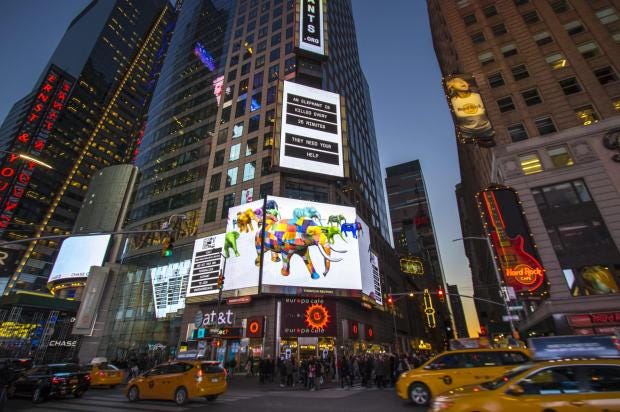
    Last year, there was the March for Giants campaign in collaboration with creative agency 18 Feet & Risisng for awareness of elephants poaching crisis and fundraiser for conservation charity Space giants. They created the world's first moving heard of elephants to 'march' globally across advertising screens from Hong Kong, New York  and London, which is he use of user generated content . More than 3,000 took part by creating their own personalised elephants and seeing their own personalised animal marching through each city.

    We know that mass-awareness campaigns such as this do not gain money but because of the 'wow' factor from the big screens, consumers and brands both recognised the value exchange from it though donators didn't see their elephant in person. 

    We see the power of technology within this company, and how advertisesrs are slowly turning to digital advertising than those of he print industry. The article itself makes it evident that the print industry is a dying medium and those who wanted to advertise before on newspapers having taken or want to take on the large bright 'wow' factor of Blade runner moving billboards to sheocase their boraducts and from the orphans vampaign we can see that even revenue is ganaibel from such things


    Tuesday, 17 October 2017

    NDM 11

    WhatsApp faces EU over sharing user data with Facebook- The Guardian

    Facebook was fined £94m in May for providing misleading information about its 2014 takeover of WhatsApp.

    The article is about the situation Whatsapp is in for breaching the user content and privacy with Facebook, which had breaches into EU law.


    •  “a clear, comprehensive resolution” in compliense to EU law-  European Union’s data regulator group
    • Facebook was fined £94m in May for providing misleading information about its 2014 takeover of WhatsApp.
    • “Over the last year we have engaged with data protection authorities to explain how our 2016 terms and privacy policy update apply to people who use WhatsApp in Europe. We remain committed to respecting applicable law and will continue to work collaboratively with officials in Europe to address their questions.”- Whatsapp spokesmen
    • WP29 action comes ahead of new, more powerful European laws called the General Data Protection Regulation, which will give regulators the power to fine companies up to 4% of global turnover.
    • “The efforts of WhatsApp and Facebook to resolve the issues have not yet addressed our concerns. We remain committed to leading a European-level response to these concerns, which affect millions of users in the UK and across the EU.” - UKs information Commissioner
    WhatsApp, is used by more than one billion people daily, had changed it privacy policy last year sharing users' phone numbers and other information with Facebook. This change in their policy creates a regulatory scrutiny  across Europe including the UK.

    The European Union’s data regulator group is focusing on Whatsapp for sharing user content and data with it's parent company Facebook. The task force, which is lead by the UK's information commissioner office, has been made by the 'pan- European data regulator', the Article 29 Wokrinf Party (WP29). The Facebook company was issued a first issued warning for its chat app for sharing user data with wider  groups whiting the Facebook company, forcing them to holt its data transfer for the chat app.
    The focus was for the requirement for users to give their consent to the sharing of their data and the level of information provided for them to make an informed choice from the app.
    The regulators picked apart the WhatsApp legal basis for consent and noted that the information given to its users about privacy policy update was “seriously deficient as a means to inform their consent”. The apps group gave a non concerned "take it or leave it approach" stating users who disliked should stop using the app all together, which the regulators found did not constitute freely given consent. While, those who agreed nonchalantly or such things as pre-ticked boxes also constitute as unambiguous consent .

    Facebook has been under a lot of scrutinity for its breach of its audiences privacy by sharing personal information among its own smaller companies but among even political powers such as my last article of Facebook sharing personal data from users to Trumps promoting group. I think this is another case where institutions are making it seems they are catering to their audiences but rather they themselves hold a lot of power in what they want is to be exposed to and which groups in countries, towns, age should be shown particular information.
    For me, peopel are witnessing a lot this year on data sharing in apps, privacy etc. From apps and how they aren't all as private as we thought. This is another reflection on targeting certain audiences with specific information such as Trumps administration knowingly targeting people who they knew would vote for them from information given by ut Facebook. 
    New technology allows these groups to make all these micro changes in their policies or updates which would go unproved to most but will have an extremely effect in what we consume daily from news to chatting apps, certainly, showing the amount of power they posses among their audiences. 


    Monday, 16 October 2017

    NDM 10

    Snapchat is American teens' favorite social media app — and Facebook can't be happy about that- Business Insider

    Image result for snapchat


    The article highlight Snapchat's gaining traction with young American teens and the growing completion between Snapchat and Facebook's Instagram. 


    • COTD_10.16_02

    The graph, which is from Piper Jaffray's bi-annual "Taking Stock With Teens" survey, highlights Snapchat's success within this year, and how other social media such as Instagram and Facebook don't come to the same impact Snapchat has on young American teens. The article also showed Facebook's increasing competition against Snapchat as they created similar features as Snap's stories on their own Instagram, creating Instagram stories and filters which were extremely similar to Snapchats'.

    I think this increase of teens using soical mdiea would be a good investment idea for brands, as Snapchat already has news sites being accessed on the app. This ability to slowly mosey their way into social media rather than their normal news sites is a good scheme for news sites, knowing they aren't getting a lot of consumers both physically and on the internet.
    The future of news could be seen through them using apps such as Snapchat and Instagram, much like Facebook, to both advertise and invest in. Instagram already advertises targeted-ads towards their young demographic, if able, to fully invest into advertising in social media apps much like Snapachat would be good to target younger generation as, from the Ofcom report is accessed by a large number of them. By putting more of a variety if news outlets on these social media apps would raise the number of the young demographic if 16-25 would be increased and social and political awareness may grow. 

    NDM 9

    There is a 'devastating' security flaw in Wi-Fi, and you're likely at risk- Business Insider


    padlock security hacking lock broken

    The article, talk of researchers finding out there is a sought of 'loophole' in Wi-fi networks. The 'loophole' led to the researchers finding that a flaw in the security used to protect Wi-fi from others, this is potential credit card details, private messages etc. being taken by hackers.
    • Any attacker needs to be on the same Wi-Fi network as you to target you.
    • A major security flaw has been found in a protocol that protects modern Wi-Fi.
    • If your phone or computer is Wi-Fi enabled then it's probably at risk, researchers say.
    The vulnerability in the security of the systems effects modern devices which include major  known brands such as Apple, Android, Windows, Linux etc.

    • "The attack works against all modern protected Wi-Fi networks," "If your device supports Wi-Fi, it is most likely affected."- Mathy Vanoef stating his findings on a website

    The actual 'loophole'/weakness was found in a protocol and it is being called a KRACK attack which is a reference to the "key reinstallation attack" that was used. From the article, it allows a hacker to intercept and read sensitive and important data being transferred from network to user. 
    It is seen as a very serious venerability in the system as it effects a large amount of devices on a large scale
    • Any attacker needs to be physically on the same Wi-Fi network as you
    • "There are plenty of nasty attacks people will be able to do this. They may be able to disrupt existing communications. They may be able to pretend to be other nodes on the network. This could be really bad ... they can definitely pretend to be non-secure resources. Almost certainly there are other problems that will come up, especially privacy issues with cheaper internet-enabled devices that have poor security."- Alex Hudson, Iron Group CTO
    The hacker just needs access to your Wi-fi, the vulnerability is done through, said hacker, being physically same network as you. Also, if a website has an additional encryption that hasn't been compromised i,e HTTP, such as a bank using it to secure financial data an attacker wouldn't be able to grab it. 
    Hudson suggests that the hackers, when attacking the security system, would look like any other 'nodes' on the network meaning it would be hard to detect if you are being hacked if it is disguised as part of the websites encryption. Also, he states this would cause more problems especially with those of which are cheap internet-enabled devices as they would more likely have poor security. 

    I think this can be seen as a negativity towards security for others. The accessibility of others information from just being on the same network is externally troublesome to those who aren't able to afford expensive security for their internet. 
    However, I find it also the fault of i.e banks, who can automatically save information onto their systems and also the inability for these websites to detect such irregular algorithms in their systems.
    I think the known flaw of new media would be it is so in-demand and mass produces, there may not be detailed care into systems and protection from hackers. Hackers have always be a problem such as the hacking of 'Ashley Madison' or those of government documents. 
    Yet, the article could outline these problems can be changed and updated, but in practice, these will take time to roll out, and not all hardware vendors will update their products in a timely fashion.

    Representing ourselves: blog task

    1) Read the article and summarise each section in one sentence. 'WHO ARE YOU?' This section is about how individuals are a...